


Nursing Assignment Help UK: Writing Reflective Practice Using Gibbs' Reflective Cycle
Nursing isn't only about learning procedures. A big part of it is admitting when you've got something wrong, dealing with how a shift made you feel, and slowly becoming more confident each time you're on the ward. That's why UK universities ask nursing students to write reflectively. The trouble is, turning something that happened on placement into a proper assignment is harder than it sounds. Nursing isn't only about learning procedures. A big part of it is admitting when you've got something wrong, dealing with how a shift made you feel, and slowly becoming more confident each time you're on the ward. That's why UK universities ask nursing students to write reflectively. The trouble is, turning something that happened on placement into a proper assignment is harder than it sounds. Plenty of students can remember every detail of what happened, yet get stuck on what they actually learned. Gibbs' Reflective Cycle helps with exactly that. Use it well, and if you need nursing assignment help UK, your reflections will tie your placement experience to what you've studied.
What Is Gibbs' Reflective Cycle in Nursing?
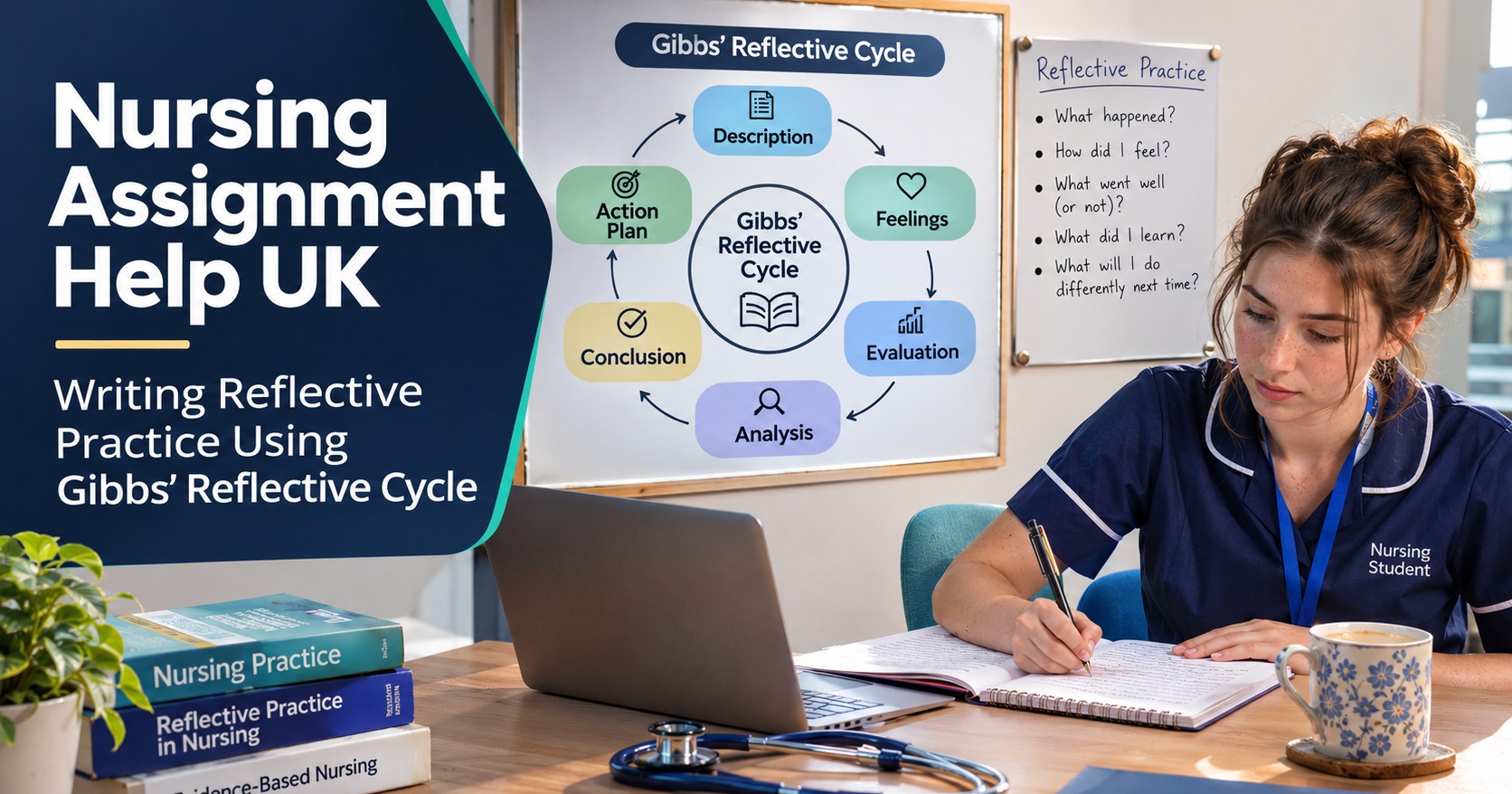
Graham Gibbs developed this model in 1988. It breaks reflection into six stages: Description, Feelings, Evaluation, Analysis, Conclusion and Action Plan.
In nursing, it gives you a way to look back at a clinical situation, work out why you reacted as you did, and see where you could do better next time.
You stop telling the story of what happened and start asking why you made the choices you did. You also think about what you'd change if it came up again.
Why Is Reflective Practice Important for Nursing Students?
Say you're on your first placement. A patient gets upset while you're helping with their care. You're nervous, and the words you want just won't come.
Later on you can't stop thinking about it. Could you have said something different? Did they feel looked after?
Reflecting is how you make use of moments like that, which otherwise just sit there feeling awkward. It makes you more self-aware, improves your communication, and gives you a clearer sense of what's expected of you when you're responsible for someone's care.
It also teaches you something many people find hard to accept: you usually start improving once you can say what you could have done differently.
Need Help with Your Dissertation?
ConnectHow to Write a Nursing Reflection Using Gibbs' Reflective Cycle
Going through the six stages in order keeps your assignment organised, and it stops you from skimming over the parts that matter.
1. Description: Explain What Happened
Pick one specific situation from your placement. For example, you might describe helping an anxious patient before a procedure.
Say what was going on, what your role was and how it ended. Keep it brief, because you don't need every little detail. And remember confidentiality. No names or anything else that could identify the patient.
2. Feelings: Explore Your Emotional Response
This is where you say what was going through your head. Nervous? Confused? Fairly confident? Did that change how you acted?
Be honest, but keep it professional rather than chatty. Writing about your feelings shows you know yourself, and it explains why you responded the way you did.
3. Evaluation: Identify What Went Well and What Didn't
Look at what worked and what didn't. Maybe you listened well to the patient's worries, but when it came to explaining the procedure, you didn't get it across clearly.
Include both. Don't beat yourself up, and don't pin it on someone else either. You're trying to understand the situation, not hand out a verdict.
4. Analysis: Connect Experience with Nursing Knowledge
Most of your marks are won or lost here, because this is where the reflection turns academic. Don't go back over what happened. Explain why it went that way.
Bring in nursing theory, professional guidance and published research. You might look at how communication feeds into patient-centred care, for instance. Use reliable sources and follow the referencing style of your university.
5. Conclusion: Tell What You Learned
What did you take away from the experience? Maybe it's that listening properly, offering some reassurance and explaining things more clearly would have helped the patient.
Then say what you'd do differently next time. Good conclusions show that you have developed since you started, rather than repeating points you have already made.
6. Action Plan: Prepare for Future Practice.
Finally, tell us what you intend to do with all this. You could work on how you communicate, ask your supervisor for feedback or spend time watching experienced nurses.
Keep the goals realistic and specific. A good action plan shows that the reflection has changed how you'll handle things in future.
Common Mistakes to Avoid in Nursing Reflective Assignments
Some students have great placement experiences and still drop marks because the reflection reads as thin.
Usually it's one of a few things. They spend most of the word count describing events, they leave their feelings out, or they don't back anything up with academic evidence. Action plans are another weak spot. Saying "I'll improve my communication" without explaining how won't get you far.
Before you hand it in, read the marking criteria again. Check that no patient could be identified, and ask yourself whether each stage adds something to what you've learned.
Need Help with Your Dissertation?
ConnectConclusion: Improve Your Reflective Writing with the Right Support
Reflective writing can feel like a lot at first, particularly when you're trying to fit placements, coursework and the rest of your life into the same week.
Gibbs' Reflective Cycle does make it easier, though. It gives you a clear way to organise your thoughts and to see how much you've grown as a future nurse.
If you're stuck on structure, critical analysis, or referencing, AskMeAssignment offers nursing assignment support built around university requirements.
Need help with your nursing reflective assignment? Head over to AskMeAssignment and get in touch with academic specialists who can walk you through Gibbs' Reflective Cycle, tighten up your writing and help you feel more confident about your coursework.
Latest Resources & Blogs
Expert tips and guides to help you succeed.

Strategic Management Assignment Help: Applying SWOT, PESTLE and Porter's Five Forces Beyond Basic Th
You've put in the hours on SWOT, PESTLE and Porter's Five Forces. You know what they are, and your assignment looks tidy. Then the marks come back with a comment you were hoping not to see: "Too descriptive. Needs more critical analysis." Annoying, right? It's also one of the most common bits of feedback business students get. Knowing the theory counts for something, but your lecturers want to see you use it to explain why a business makes the decisions it does. The fix isn't more reading. It's a change in how you use what you've already read. Once that clicks, these assignments get a lot easier to handle.

Corporate Finance Assignment Help: Common Calculation Mistakes and How to Show Your Workings So Mark
Most people don't lose marks in corporate finance because they can't do the maths. It's usually something smaller. A discount rate typed in wrong, a cash flow in the wrong year, a final answer with no explanation next to it. You can know the theory inside out and still drop a grade over stuff like that. If you're studying at a UK uni, there's another layer too. Your marker doesn't only want the right number. They want to see how you got it and what it means for the business. Here's where things tend to go wrong, and how to lay out your work so the marks are easy to give.

Assignment Marking Criteria Explained: How UK Universities Grade 2:1 and First-Class Work
You've put days into this one. Research done, references checked, and you've read it through a couple of times before submitting. Honestly, you think it's pretty good. Then 65% comes back. It's a decent mark, but now you're staring at it, wondering what on earth it would have taken to get 70. Loads of UK students end up here. A 2:1 and a First can look surprisingly similar on the page, so it's hard to spot what's missing. Once you understand assignment marking criteria, though, it gets a lot easier to see what your lecturers want and where you can push your work further.