


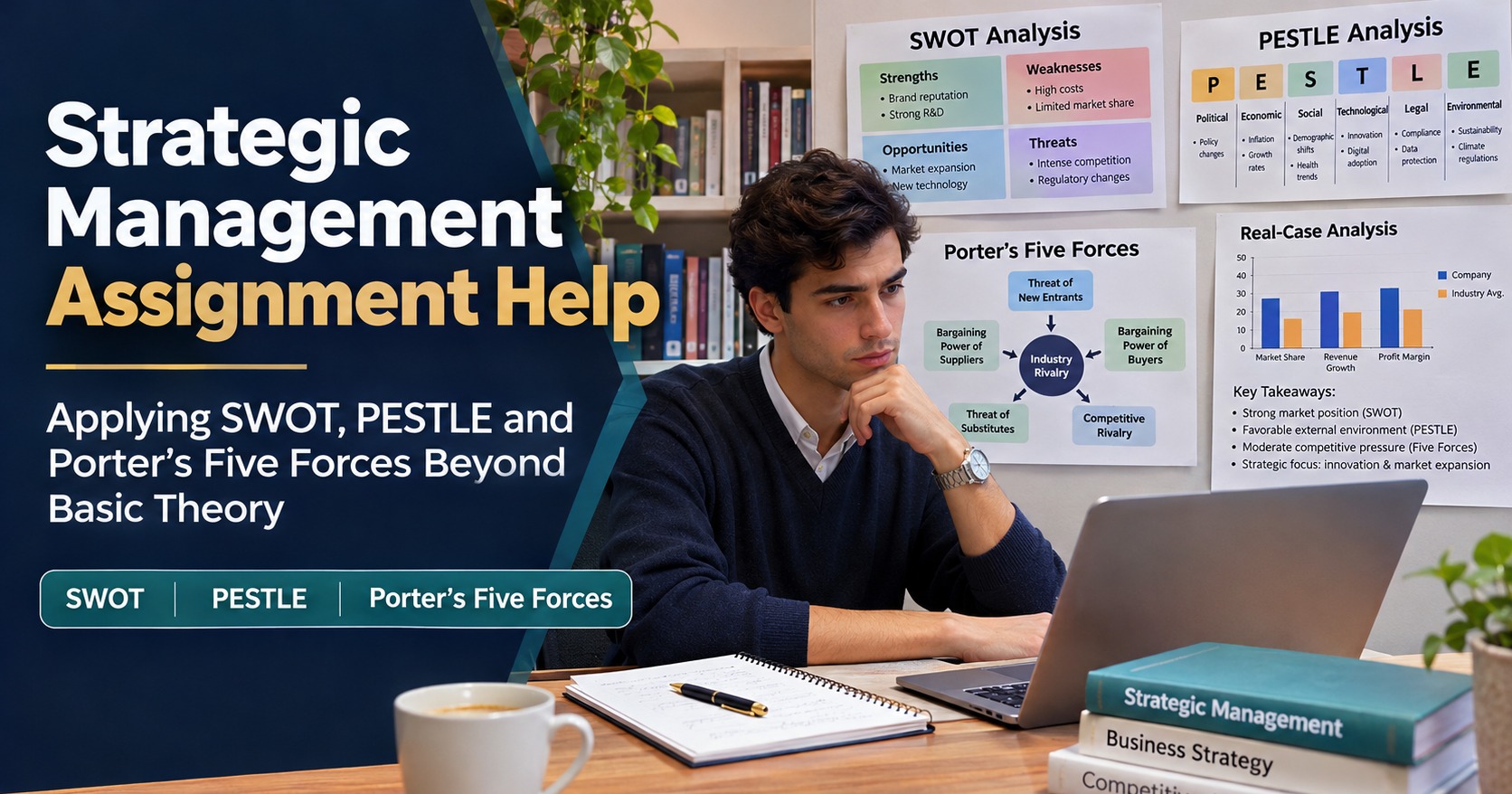
Strategic Management Assignment Help: Applying SWOT, PESTLE and Porter's Five Forces Beyond Basic Theory
You've put in the hours on SWOT, PESTLE and Porter's Five Forces. You know what they are, and your assignment looks tidy. Then the marks come back with a comment you were hoping not to see: "Too descriptive. Needs more critical analysis." Annoying, right? It's also one of the most common bits of feedback business students get. Knowing the theory counts for something, but your lecturers want to see you use it to explain why a business makes the decisions it does. The fix isn't more reading. It's a change in how you use what you've already read. Once that clicks, these assignments get a lot easier to handle.
Why Strategic Management Assignments Need More Than Theory
Strategic management is really about how organisations make choices, deal with competitors and plan for what's coming.
When you explain a framework, you're showing you've done the reading. When you apply it to an actual business, you're showing you understand it. Markers can tell the difference straight away.
Take inflation. Saying "inflation affects businesses" is just a statement. Saying it pushes up running costs, makes customers more careful with their money and forces companies to rethink their prices? Now you're analysing.
Most assessors are looking for a link between the theory, solid evidence and a recommendation that makes sense in practice. And don't try to fit in every framework you've ever learned. Choose the ones that help answer your question and leave the rest.
Applying SWOT Analysis to Real Business Problems
SWOT splits things into strengths, weaknesses, opportunities and threats, with the first two coming from inside the business and the other two from outside.
Many students fill in the four boxes and call it done. But the table doesn't say anything on its own.
Say you're looking at a made-up UK clothing retailer. Loyal customers and a decent online store are clear strengths. Rising delivery costs and a small international footprint look more like weaknesses.
So what? That's the question to ask next. Could those loyal customers be the way into a subscription service? Is going abroad likely to bring in more than it costs the company in risk?
Once you start asking that kind of thing, your SWOT stops being a table and starts being an argument.
Practical tip: For every point you list, write a line or two on how it affects the business and what management might do about it.
Need Help with Your Dissertation?
ConnectUsing PESTLE Analysis to Understand Business Environments
No business sits in isolation. Government rules, the economy and new technology can all throw a spanner in even a well-thought-out plan.
PESTLE covers six outside factors: political, economic, social, technological, legal and environmental.
Let's say you're analysing a UK hospitality business. Energy bills are going up, which hurts profit. At the same time, customers seem to care more about sustainability, which could help.
If you only list those, the assignment stays descriptive. What gets you the marks is asking what the business should do. Does it spend money on energy-efficient kit? Put prices up a little? Start running in a greener way?
Also, you don't need to give all six factors the same airtime. Stick with the ones that really shape the decisions in front of you.
Practical tip: Use UK statistics, industry reports and reputable business sources to back up what you're saying.
Porter's Five Forces: Looking Beyond Competitor Lists
Porter's Five Forces looks at the pressure on an industry from five directions: existing rivals, new entrants, substitutes, suppliers and buyers.
The mistake we see most often is students treating it as a list of competitors. It's wider than that.
Think about a made-up independent coffee shop up against the big chains. The café across the road is only part of the problem. Customers might just make coffee at home, a supplier might raise prices, and someone new could open up round the corner.
The useful bit is working out how each of those hits profit. Could the shop stand out by sourcing locally? Would a closer deal with its suppliers keep costs down?
Linking the pressures to possible responses shows you're thinking strategically, rather than copying out the textbook.
Need Help with Your Dissertation?
ConnectHow to Combine SWOT, PESTLE and Porter's Five Forces
The three work best when they feed into each other.
Say PESTLE shows demand for sustainable products is growing. Porter's Five Forces then shows the market is already crowded. SWOT helps you decide whether this particular business has the people, money and know-how to go for it.
Put those together, and your recommendation will be far more balanced. The question to keep coming back to is simple: what's the best opportunity here that the organisation can realistically pull off?
It's also fair to say what your analysis can't tell you. Information is often patchy, forecasts can be wrong, and markets change quickly. Saying so makes your work more credible, not less.
Common Mistakes That Weaken Strategic Management Assignments
Even a well-researched piece of work can lose marks when students:
Repeat definitions without applying them.
Make claims about a company's performance without support.
Add irrelevant points just to fill a framework.
Recommend something without saying whether it's actually doable.
Skip over evidence that cuts against their argument, or ignore the risks.
Most of this is avoidable with a bit of planning, some critical thinking and careful referencing throughout.
Need Help with Your Dissertation?
ConnectConclusion: Turn Strategic Knowledge into Stronger Analysis
A good strategic management assignment isn't there to prove you can remember theories. It's there to show you can weigh up evidence, spot the problems and suggest solutions that would work.
SWOT, PESTLE and Porter's Five Forces give you the structure. What you make of them is what earns the grade.
If you're stuck on linking theory to real examples, Ask Me Assignment offers strategic management assignment help for UK university students. Whether you want help making sense of the brief, organising your research or building a more critical argument, have a look at their academic support services and take the next step towards an assignment you feel good about.
Latest Resources & Blogs
Expert tips and guides to help you succeed.
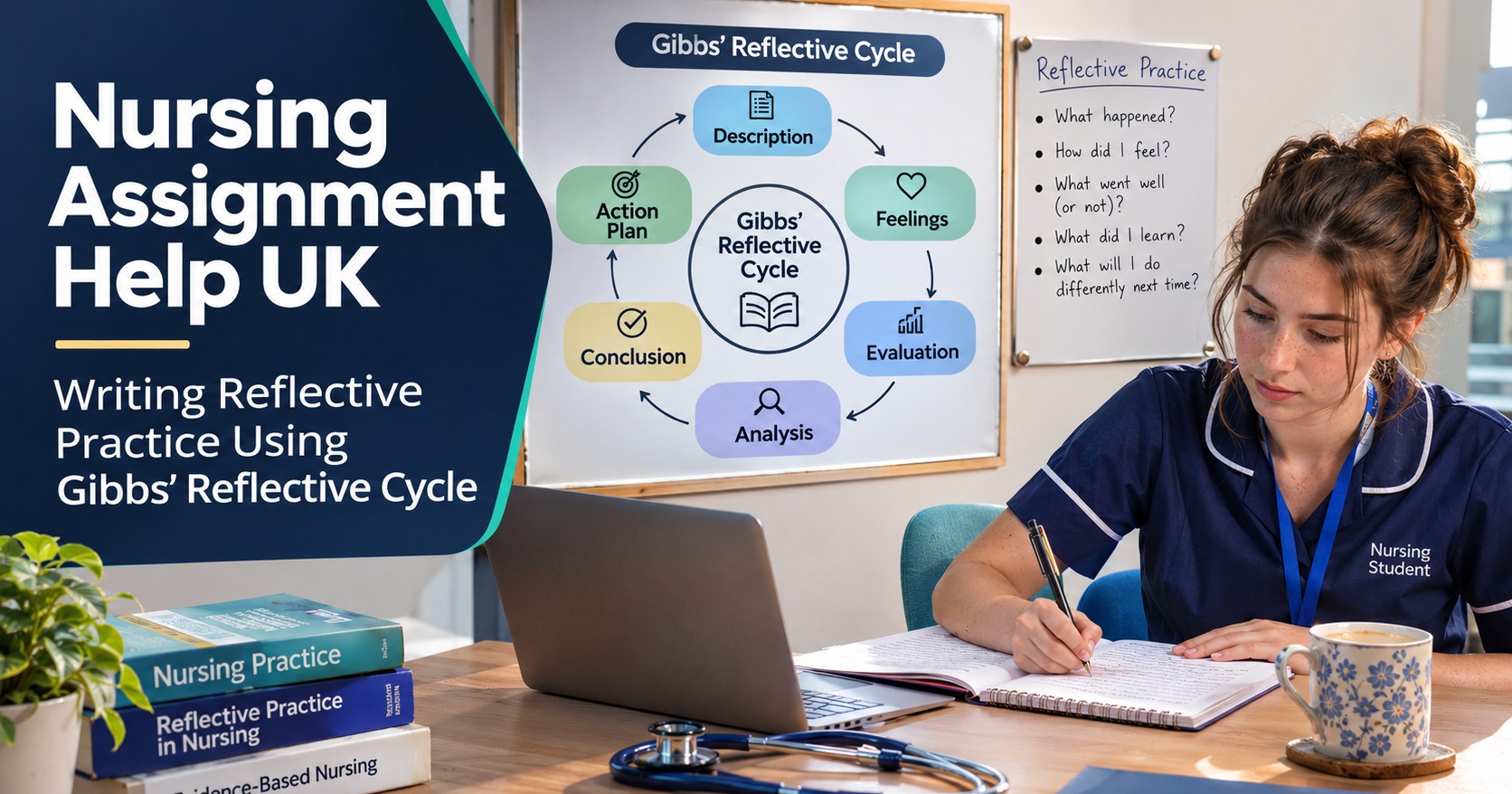
Nursing Assignment Help UK: Writing Reflective Practice Using Gibbs' Reflective Cycle
Nursing isn't only about learning procedures. A big part of it is admitting when you've got something wrong, dealing with how a shift made you feel, and slowly becoming more confident each time you're on the ward. That's why UK universities ask nursing students to write reflectively. The trouble is, turning something that happened on placement into a proper assignment is harder than it sounds. Nursing isn't only about learning procedures. A big part of it is admitting when you've got something wrong, dealing with how a shift made you feel, and slowly becoming more confident each time you're on the ward. That's why UK universities ask nursing students to write reflectively. The trouble is, turning something that happened on placement into a proper assignment is harder than it sounds. Plenty of students can remember every detail of what happened, yet get stuck on what they actually learned. Gibbs' Reflective Cycle helps with exactly that. Use it well, and if you need nursing assignment help UK, your reflections will tie your placement experience to what you've studied.
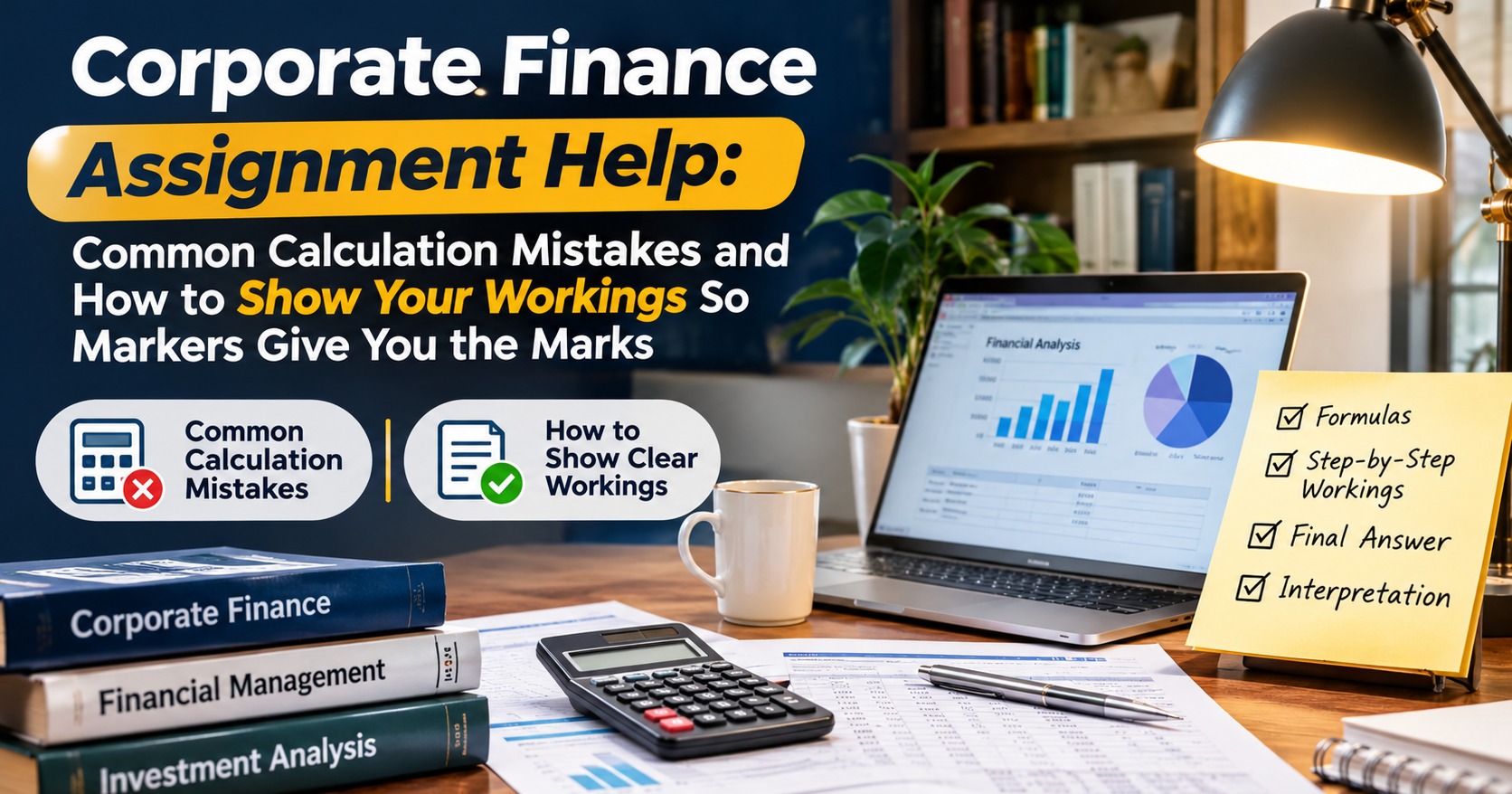
Corporate Finance Assignment Help: Common Calculation Mistakes and How to Show Your Workings So Mark
Most people don't lose marks in corporate finance because they can't do the maths. It's usually something smaller. A discount rate typed in wrong, a cash flow in the wrong year, a final answer with no explanation next to it. You can know the theory inside out and still drop a grade over stuff like that. If you're studying at a UK uni, there's another layer too. Your marker doesn't only want the right number. They want to see how you got it and what it means for the business. Here's where things tend to go wrong, and how to lay out your work so the marks are easy to give.

Assignment Marking Criteria Explained: How UK Universities Grade 2:1 and First-Class Work
You've put days into this one. Research done, references checked, and you've read it through a couple of times before submitting. Honestly, you think it's pretty good. Then 65% comes back. It's a decent mark, but now you're staring at it, wondering what on earth it would have taken to get 70. Loads of UK students end up here. A 2:1 and a First can look surprisingly similar on the page, so it's hard to spot what's missing. Once you understand assignment marking criteria, though, it gets a lot easier to see what your lecturers want and where you can push your work further.