



Harvard Referencing Guide for UK Students: Citation Examples for Books, Journals and Websites
Referencing can feel like a small detail at the end of an assignment, but it helps readers see where your ideas and evidence came from. Getting it right also shows that you have engaged with your sources and gives credit to the people who produced them. Harvard referencing uses an author and date in the body of your work, alongside a full reference at the end. The details can vary between universities, though, so use your department’s guide if it gives different instructions. There isn’t one version of Harvard that every UK university follows.
How Harvard referencing works
Harvard referencing has two parts:
An in-text citation appears where you use a source in your assignment. It usually gives the author’s surname and the year of publication.
A full reference appears in your reference list and gives the reader enough information to find the source.
For example, if you paraphrase an author called Smith whose book was published in 2022, your in-text citation might look like this:
Effective planning can help students manage a complex project (Smith, 2022).
The full reference for Smith’s book would then appear in the reference list. If you quote the author’s exact words, include a page number where one is available. The exact punctuation and layout can differ between university guides.
How to reference a book
A typical book reference includes the author, publication year, book title, edition if it is not the first, and publisher. Some Harvard guides also ask for the place of publication, so check your university’s preferred format.
General format:
Surname, Initial. (Year) Title of book. Edition, if applicable. Publisher.
Example:
Ronson, J. (2012) The psychopath test: a journey through the madness industry. London: Picador.
In-text citation:
(Ronson, 2012)
This example follows UCL’s Harvard guide. Other institutions may format the same details differently. If you are using an ebook, check whether your guide treats it like a printed book or asks you to include an online link.
Need Help with Your Dissertation?
ConnectHow to reference a journal article
A journal article reference usually includes the article’s author and title, the journal title, volume and issue number, page range, and DOI if there is one.
General format:
Surname, Initial. (Year) ‘Title of article’, Title of Journal, volume(issue), pp. page range. DOI, if available.
Example:
Skelton, A. (2011) ‘Value conflicts in higher education teaching’, Teaching in Higher Education, 17(3), pp. 257–268. doi: 10.1080/13562517.2011.611875.
In-text citation:
(Skelton, 2011)
If you found the article online, you may still reference it as a journal article rather than as a web page. Whether you need to include a DOI or access details depends on the source and your university’s rules.
How to reference a website
For a web page, record the author or organisation, the year it was published or last updated, the page title, its URL and the date you accessed it. If no individual author is named, the organisation responsible for the page may be used.
General format:
Author or organisation (Year) Title of web page. Available at: URL (Accessed: day month year).
Example:
BBC News (2014) ‘“Lights out” ends day of WW1 centenary commemorations’. Available at: http://www.bbc.co.uk/news/uk-28632223 (Accessed: 17 October 2022).
In-text citation:
(BBC News, 2014)
Web pages can change, which is why a guide may ask for the date you accessed them. If a page has no named author or publication date, follow your university’s instructions for missing details rather than guessing.
Need Help with Your Dissertation?
ConnectCiting sources in your assignment
Add a citation whenever you quote, summarise or paraphrase someone else’s work. A paraphrase still needs a citation: changing the wording does not make the original idea your own.
For a direct quotation, use quotation marks and include a page number if the source has pages:
“Quoted words from the source” (Author, Year, p. 24).
For an idea discussed across more than one page, your guide may ask you to use a page range. If you cannot find page numbers, check whether it recommends a paragraph number or another locator.
When a source has several authors, the way you shorten the in-text citation can vary. Some guides use et al. after the first author for sources with a certain number of authors. Check your university’s example so you apply the same rule throughout.
Reference list or bibliography?
A reference list contains the sources you cited in your assignment. A bibliography may also include material you read for background but did not cite. Some courses ask for both; others only require a reference list. Follow the instructions in your assignment brief or ask your tutor if you are unsure.
Need Help with Your Dissertation?
ConnectCommon Harvard referencing mistakes
A few quick checks can help you catch errors before you submit:
Every in-text citation has a matching full reference. Check that names and dates match.
Every source in the reference list is cited in your work, unless your assignment asks for a bibliography as well.
You have recorded the source details as you researched. It is much harder to find a page number or publication date later.
You have included page numbers for direct quotations when the source provides them.
Your formatting is consistent. Apply the same version of Harvard throughout, including punctuation, italics and access dates.
You have followed your course guide. A reference generator can help organise details, but its output may not match your department’s exact requirements.
Latest Resources & Blogs
Expert tips and guides to help you succeed.
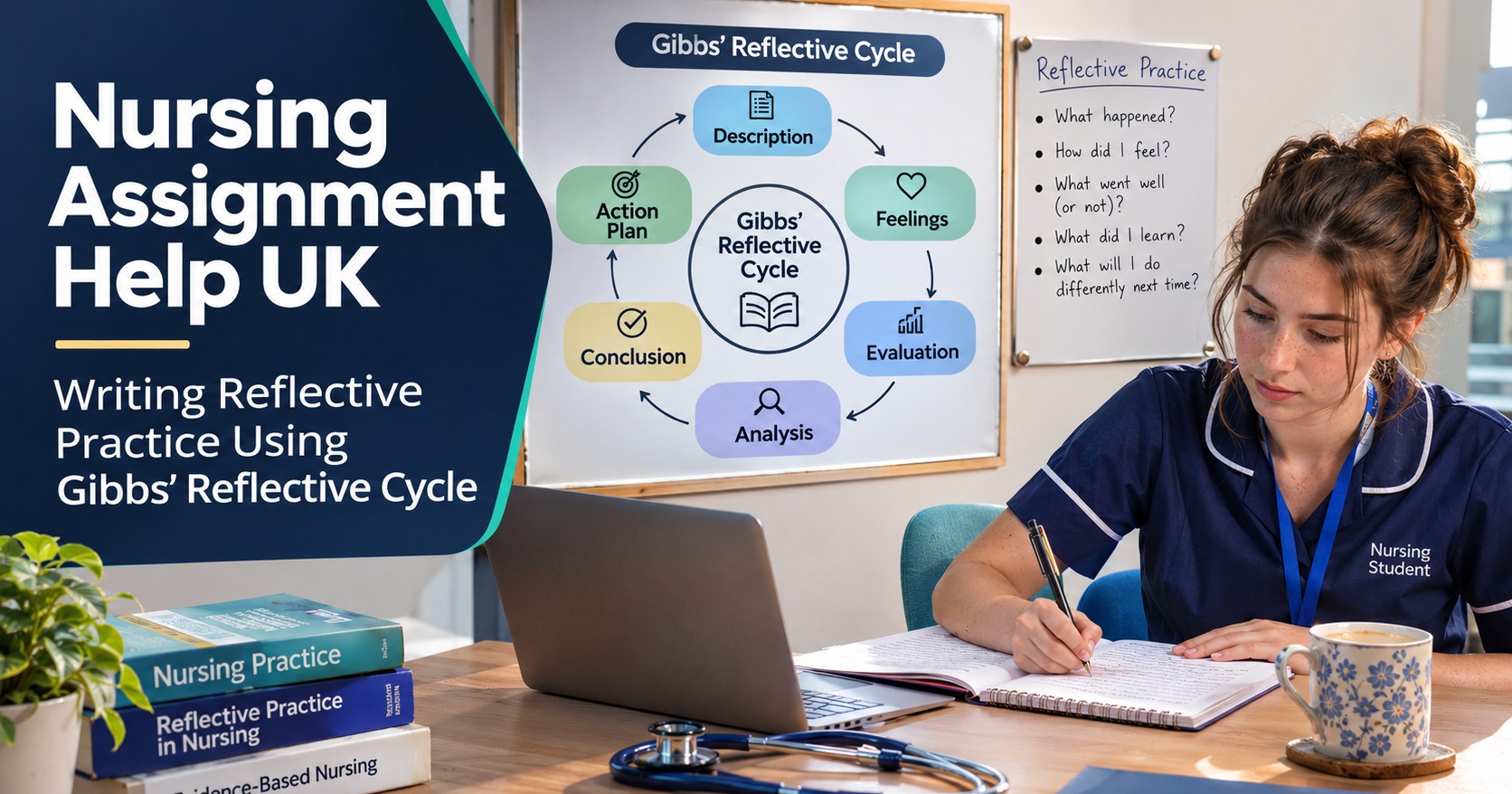
Nursing Assignment Help UK: Writing Reflective Practice Using Gibbs' Reflective Cycle
Nursing isn't only about learning procedures. A big part of it is admitting when you've got something wrong, dealing with how a shift made you feel, and slowly becoming more confident each time you're on the ward. That's why UK universities ask nursing students to write reflectively. The trouble is, turning something that happened on placement into a proper assignment is harder than it sounds. Nursing isn't only about learning procedures. A big part of it is admitting when you've got something wrong, dealing with how a shift made you feel, and slowly becoming more confident each time you're on the ward. That's why UK universities ask nursing students to write reflectively. The trouble is, turning something that happened on placement into a proper assignment is harder than it sounds. Plenty of students can remember every detail of what happened, yet get stuck on what they actually learned. Gibbs' Reflective Cycle helps with exactly that. Use it well, and if you need nursing assignment help UK, your reflections will tie your placement experience to what you've studied.

Strategic Management Assignment Help: Applying SWOT, PESTLE and Porter's Five Forces Beyond Basic Th
You've put in the hours on SWOT, PESTLE and Porter's Five Forces. You know what they are, and your assignment looks tidy. Then the marks come back with a comment you were hoping not to see: "Too descriptive. Needs more critical analysis." Annoying, right? It's also one of the most common bits of feedback business students get. Knowing the theory counts for something, but your lecturers want to see you use it to explain why a business makes the decisions it does. The fix isn't more reading. It's a change in how you use what you've already read. Once that clicks, these assignments get a lot easier to handle.
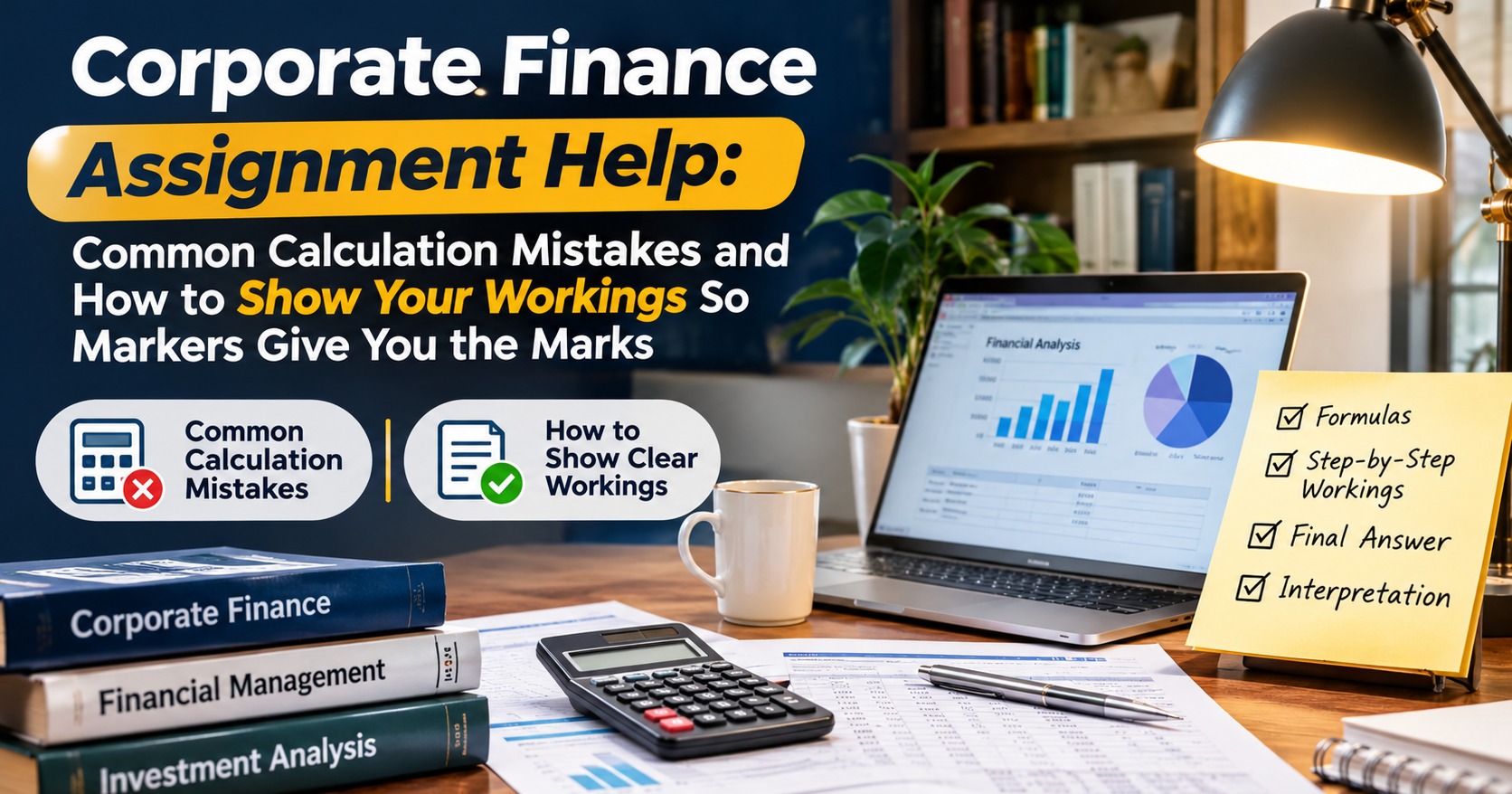
Corporate Finance Assignment Help: Common Calculation Mistakes and How to Show Your Workings So Mark
Most people don't lose marks in corporate finance because they can't do the maths. It's usually something smaller. A discount rate typed in wrong, a cash flow in the wrong year, a final answer with no explanation next to it. You can know the theory inside out and still drop a grade over stuff like that. If you're studying at a UK uni, there's another layer too. Your marker doesn't only want the right number. They want to see how you got it and what it means for the business. Here's where things tend to go wrong, and how to lay out your work so the marks are easy to give.